

Upgrading Private Clinic Governance – Why Compliance Nursing Directors Are Swapping Spreadsheets for Vantage
Every single year across England, an estimated 237 million medication errors occur within the NHS ecosystem alone, costing the health service upwards of £98.5 million in avoidable bed days and contributing to hundreds of preventable deaths. While many of these incidents are caught before reaching a patient, a staggering portion of the administrative vulnerabilities can be traced straight back to how clinical information is tracked, shared, and monitored.
Minimising these administrative gaps requires an incident management framework like ours, which transforms these errors from costly statistics into actionable insights for continuous improvement.
For decades, the standard response to a new regulatory requirement, a risk assessment, or an incident log has been to open a new tab on a spreadsheet. Across clinical safety teams, ward managers, and compliance leads, thousands of highly trained healthcare professionals find themselves trapped behind desk screens, manually copying rows of data and chasing lost files. The tools meant to simplify tracking have quietly transformed into a massive administrative burden that drains crucial operational hours away from frontline patient care.
Manual compliance is no longer just an administrative irritation. It is a systemic operational risk that compromises data security, accelerates staff burnout, and obscures the real-time insights required to keep patients safe. Moving past fragmented documents is the most direct way to protect your workforce, satisfy modern regulatory frameworks, and return valuable hours to the bedside.
Key Takeaways
- Hidden resource drain – Managing clinical compliance through manual spreadsheets consumes thousands of administrative hours every year, directly increasing workforce fatigue and reducing active time for patient care.
- The data reliability gap – Manual data entry creates major risks for transcription mistakes, broken formula links, and delayed updates, leaving healthcare organisations exposed during regulatory reviews.
- Proactive regulatory alignment – Modern oversight frameworks demand real-time validation and evidence-based tracking that static, isolated documents simply cannot sustain.
- The value of centralisation – Transitioning to dedicated compliance software like ours at Vantage automates risk reporting, unifies audit trails, and unlocks the proactive insights needed to prevent incidents before they occur.
The High Cost of Spreadsheets
The spreadsheet is one of the most familiar tools in any office environment. It is free, highly customisable, and requires no specialist procurement sign-off to set up. For a busy clinic or a single department looking to track a minor asset inventory, it feels like the path of least resistance.
The trouble begins when this short-term convenience scales up into a long-term strategy for managing complex clinical risks, Patient Safety Incident Response Framework compliance, or Care Quality Commission evidence logs. What works well for a basic financial budget becomes dangerous when applied to the multi-layered realities of modern healthcare quality assurance.
When your compliance strategy relies on rows and columns stored in disconnected network folders, the true operational cost remains completely hidden from view. You do not see the cost on a software invoice, but you see it in the highly paid clinical leads spending their Sunday evenings formatting cells, cross-referencing staff training matrices, or building makeshift pivot tables to prepare for an upcoming audit.
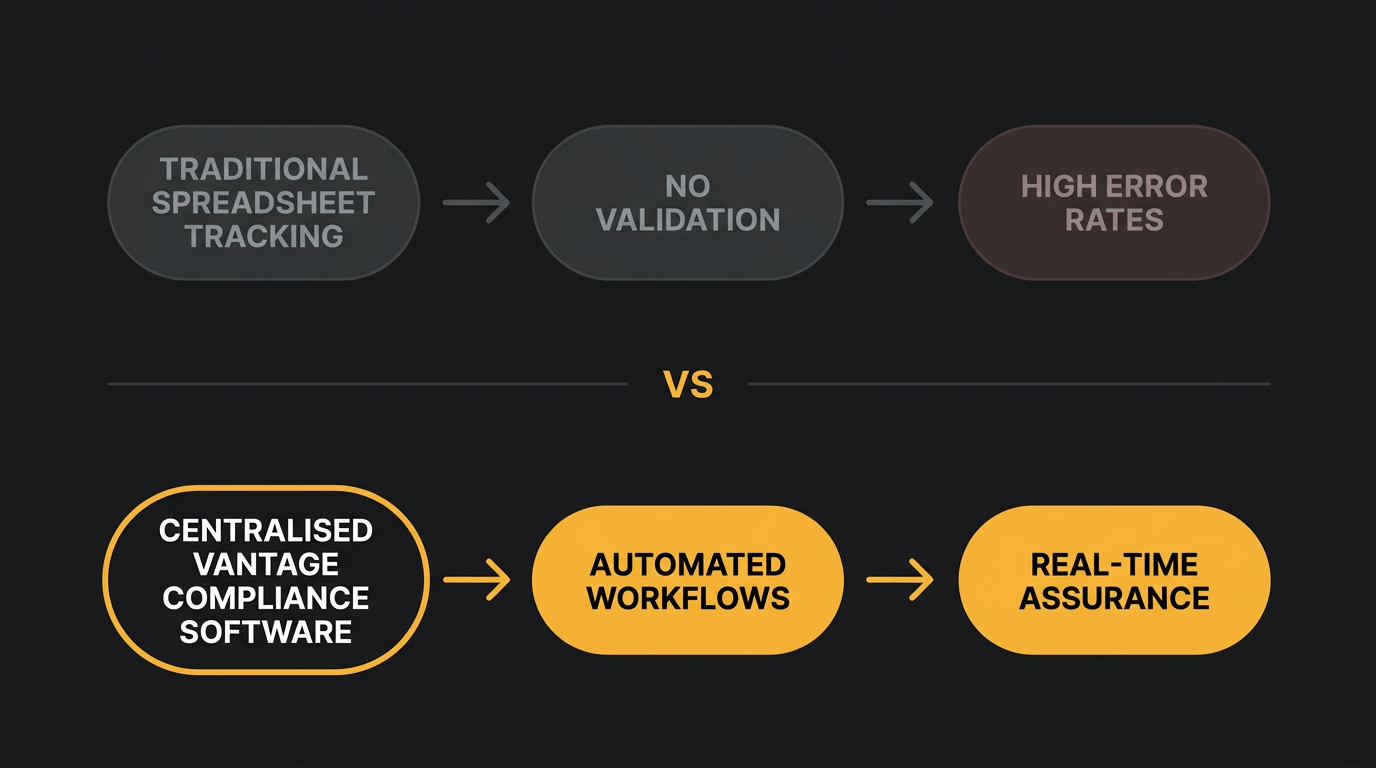
Furthermore, standard spreadsheets lack the structure required for sensitive healthcare information. They lack the more granular user permission settings, definitive version controls, and unalterable audit histories. If a user accidentally deletes a row of historical incident logs or overwrites a formula that calculates compliance percentages, that data can vanish without a trace. The organisation is left exposed, operating on incomplete data while assuming everything is fully compliant.
The financial impact extends directly into regulatory penalties and lost productivity. When compliance data is scattered across personal desktops, responding to an unexpected inspection turns into an all-hands-on-deck emergency. Routine operations grind to a halt as teams scramble to locate missing documents, verify outdated entries, and stitch together a cohesive story for inspectors. The humble spreadsheet stops being a free tool and becomes a massive operational drain.
What Are The Time Traps of Scattered Data Tracking?
Consider the typical lifecycle of a clinical incident report managed via a manual tracking system. A nurse on a night shift fills out a local form. That form is emailed to a department head, who extracts the text and pastes it into a departmental spreadsheet. At the end of the month, that spreadsheet is merged into a divisional master document, which is then sent to the corporate risk team to be manually combined into a trust-wide dashboard.
This is the ultimate administrative time trap. At every single step of this chain, data must be chased, verified, and re-keyed.
- The updates chase – compliance leads spend a significant portion of their week emailing individual ward managers to ask if their local tracking sheets have been updated for the month.
- The missing context riddle – when an entry reads “equipment failure,” a risk officer must track down the original reporter via phone or email to find out which specific asset failed and whether a patient was impacted.
- The compilation bottleneck – by the time all the separate documents are collected, cleansed, and manually merged into a single report, the information is already several weeks out of date.
This constant administrative loop means that healthcare leaders are always looking backwards. They are evaluating data that reflects the state of the organisation a month ago, rather than seeing what is happening right now.
This lag is particularly problematic under modern regulatory approaches, such as the single assessment framework used by regulators to monitor providers continuously. Modern oversight relies on a dynamic, ongoing relationship with data, moving away from historic, one-off inspection dates. If your organisation takes three weeks to compile an incident trend report because the data is trapped across twelve separate documents, you cannot provide the agile, proactive proof of safety that modern compliance demands.
To meet these new inspection standards without the extra paperwork, healthcare providers need a system that brings scattered data together instantly. At Vantage, we’re your all-in-one solution.
Human Error and the Reliability Gap in Clinical Safety
Whenever a human being is required to copy data from one document to another, mistakes are inevitable. In a busy clinical environment where phones are ringing, alarms are sounding, and urgent staff questions occur every few minutes, the likelihood of data entry mistakes rises dramatically.
In clinical safety tracking, a simple typo is not just an eyesore, it can actively cause a serious systemic issue. If an administrative team member enters an incorrect date or miskeys a location code, a cluster of related incidents across different wards might look like entirely isolated events. The safety team misses the pattern, the root cause goes unaddressed, and the risk remains active.
A major driver of this reliability gap is the complete lack of data validation in standard spreadsheets.
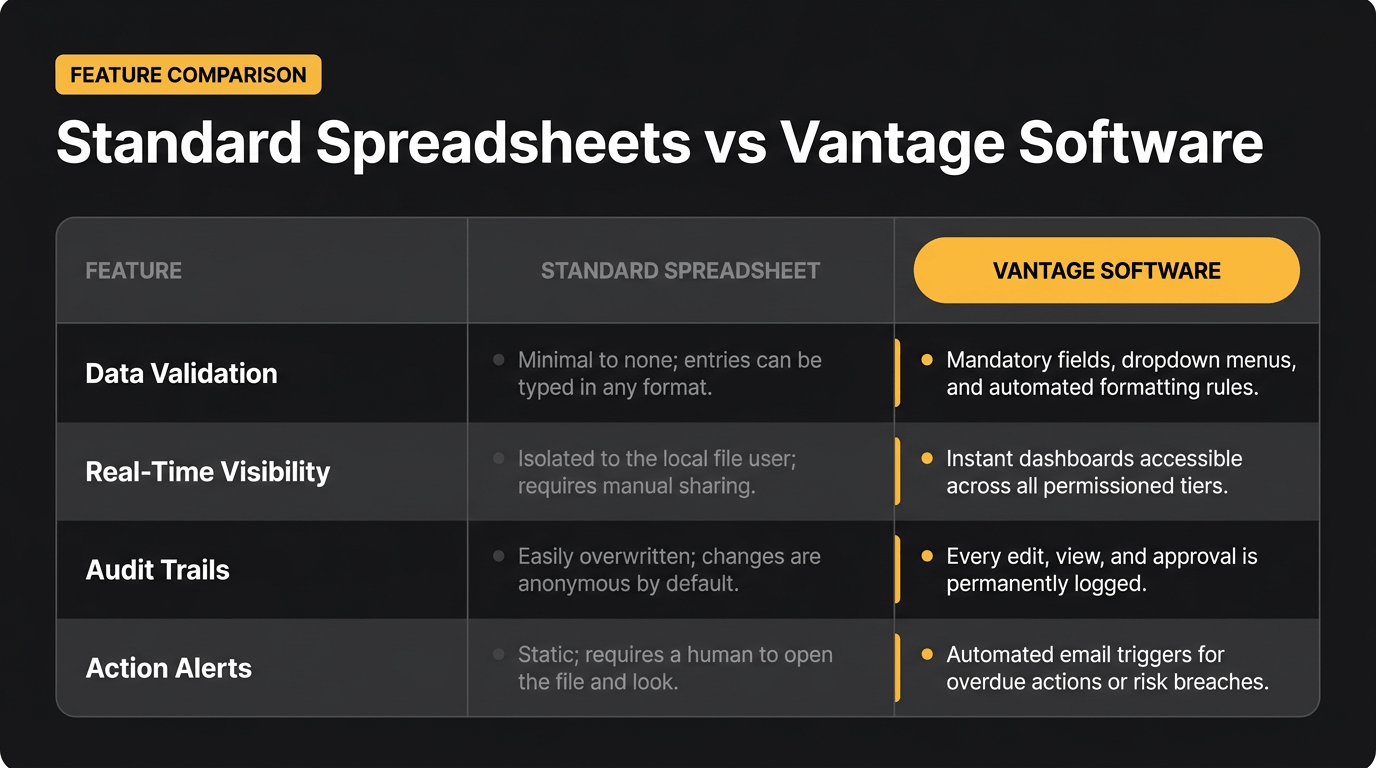
Without system-enforced rules, one user might log an incident under “Ward 3,” another under “W3,” and a third under “Maternity Ward 3.” To a computer generating a report, these are three completely different locations.
The resulting data hygiene issues require hours of manual cleaning before any meaningful analysis can even begin. More importantly, this reliable information gap removes leadership trust. When an executive board or an external inspector looks at a compliance report and spots obvious inconsistencies or outdated metrics, the credibility of the entire organisation’s governance system is thrown into question.
The easiest way to stop these mistakes is to use a system that standardises your data automatically from the moment it is entered.
The Strategic Solution – Shifting to Centralised Software
The alternative to this cycle of chasing rows and columns is a transition to dedicated, centralised compliance software. This shift moves your organisation away from reactive data collection and replaces it with an integrated ecosystem where risk management, audit trails, and policy reviews live under a single digital roof.
Centralised software like ours acts as a single, verified source for the entire enterprise. When an incident is logged on a ward, it instantly registers on the central compliance dashboard. There is no copying, no manual emailing, and no lag time. The system automatically routes the information to the correct stakeholders based on pre-set workflows, ensuring that serious risks are escalated immediately rather than sitting unread in an inbox until the next monthly review.
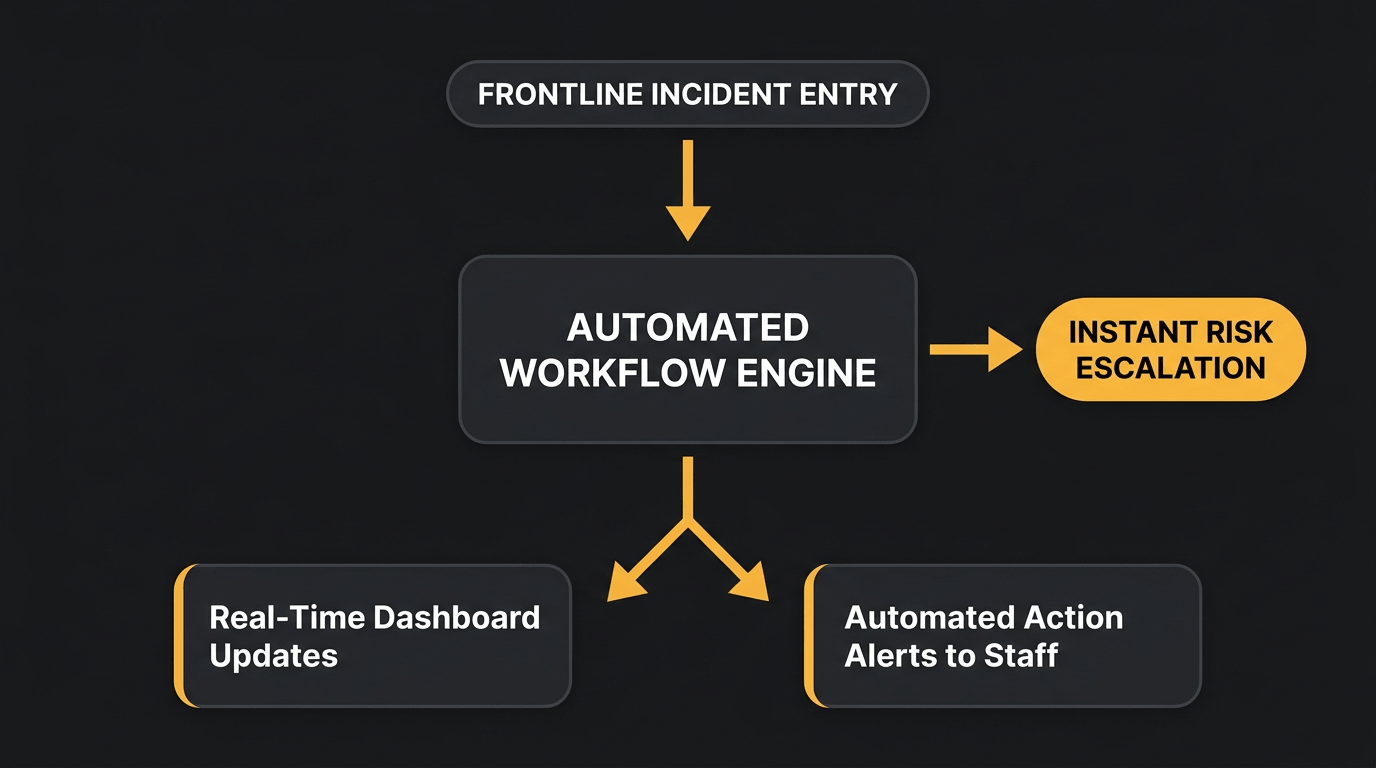
This structural shift transforms compliance from a box-ticking exercise into a proactive management tool. Rather than spending energy trying to gather data, compliance teams can focus their expertise on analysing what the data actually means.
If the system highlights an uptick in medication errors or reveals that a specific policy review is overdue, leaders can deploy support precisely where it is needed most. This approach allows healthcare organisations to move beyond mere compliance tracking and actively build a sustainable culture of continuous improvement and safety.
How Automation Restores the Focus on Patient Care
The biggest benefit of removing manual compliance tracking is the direct, positive impact it has on your workforce. Healthcare professionals do not choose their careers to manage rows of data or fix broken spreadsheet links. They enter the field to care for people.
The persistent growth of administrative tasks is a documented driver of workforce fatigue and stress across the healthcare sector. When a clinical lead spends hours every week updating and managing compliance logs, that represents time directly stolen from supervising junior staff, reviewing complex patient cases, or supporting patients on the floor.
Automation changes this equation entirely by handling the repetitive administrative tasks behind the scenes.
- Automated reminders – The software automatically emails a clinician when a specific training module or risk assessment needs updating, removing the need for a manager to track them down.
- Smart form pre-population – Incident reports automatically pull in relevant staff details, location data, and time logs from core systems, reducing the time required to complete a report from twenty minutes to a few clicks.
- Instant report generation – Board-ready compliance packs, CQC evidence folders, and internal trend analysis can be generated instantly, replacing days of manual consolidation.
By eliminating these friction points, you give your teams their time back. A nurse can spend their afternoon on clinical quality improvement rather than updating data entries. A manager can run interactive safety sessions with frontline teams instead of wasting time with spreadsheet layouts.
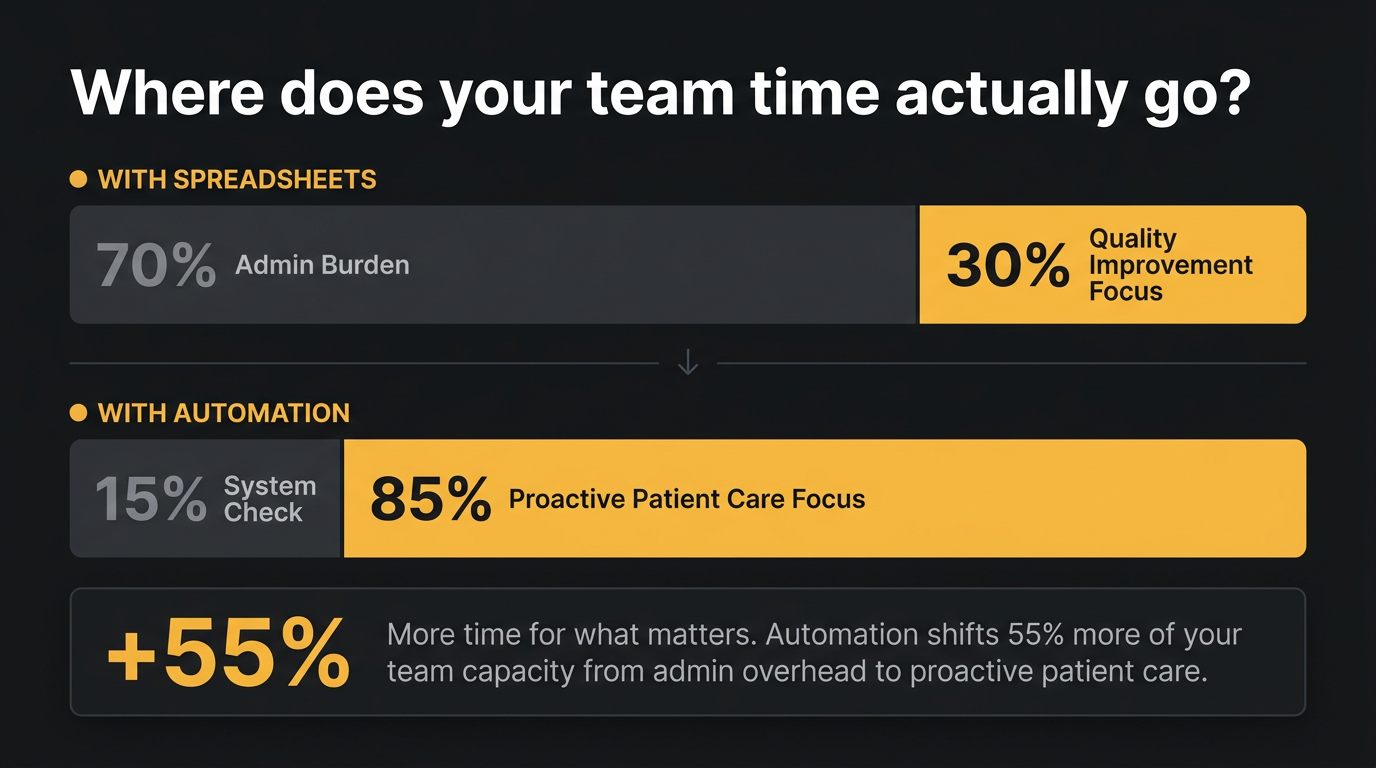
When software takes over the heavy lifting of data organisation, compliance stops being a barrier to care and becomes an invisible framework that supports the entire operation.
Final Thoughts
The shift away from spreadsheets is not just a technological upgrade; it is an investment in your organisation. Healthcare environments are complex, fast-moving, and demanding. The management tools supporting them must match that.
Continuing to run high-stakes clinical compliance on manual documents is an expensive approach that drains your staff’s energy and exposes your organisation to significant risk. At Vantage, our compliance & quality management software transforms this dynamic completely, shifting your focus from historical record-keeping to real-time, proactive risk reduction.
By automating administrative tasks and creating a clear, reliable source of truth, you protect your regulatory standing and reduce human error. Most importantly, you free your highly skilled teams from the screen, returning them to where they are needed most, with the patients.